Offensive Operations with AI: Using AI-Orchestrated Reconnaissance in Real Assessments
Introduction
Offensive operations have always involved a lot of manual labour. Enumeration, correlation, attack surface analysis, and hypothesis testing often take more time than exploitation itself. In today’s environments, sprawling infrastructure, layered technologies, and rapidly shifting attack surfaces, the effort is only magnified.
This is where artificial intelligence is starting to shape offensive tradecraft. Not by replacing operators, but by helping them.
When integrated into offensive workflows, AI can assist in automating repetitive tasks, correlating findings across tools, prioritising interesting signals, and enabling faster decision-making. Operators can start using AI to orchestrate workflows rather than discrete utilities, making reconnaissance a more adaptive and intelligence-driven process.
That shift is becoming more and more relevant in offensive security. One of the best examples of this is AI-assisted reconnaissance.
In this article, we will explore how AI can support offensive operations through an AI-orchestrated reconnaissance pipeline, using a practical target assessment as an example.
Why AI in Offensive Operations Makes Sense
Reconnaissance is often the most time-consuming part of offensive operations, and it often misses valuable opportunities.
Discovery tools generate large quantities of data, but it still requires correlation, prioritisation, and continual operator decision-making to interpret it. This is where smart orchestration can make a difference.
AI can help to treat these as part of a coordinated workflow, rather than manual movement between subdomain enumeration, port discovery, technology fingerprinting, endpoint discovery, and vulnerability research as disconnected phases.
Signals found in one phase can influence the next. Good hosts can lead to more in-depth analysis. The Technologies Detected can guide your Enumeration Strategy.
Attack hypotheses can be fed by historical findings.
That’s intelligence generation instead of collection for reconnaissance. And that’s where AI really adds value to offensive operations.
Example: AI-Orchestrated Reconnaissance Pipeline in Practice
To demonstrate this, consider a practical target http://testasp.vulnweb.com
Rather than relying on manual sequencing of tools, the workflow uses AI in the loop to orchestrate discovery, correlate results and adapt analysis based on findings as they emerge.
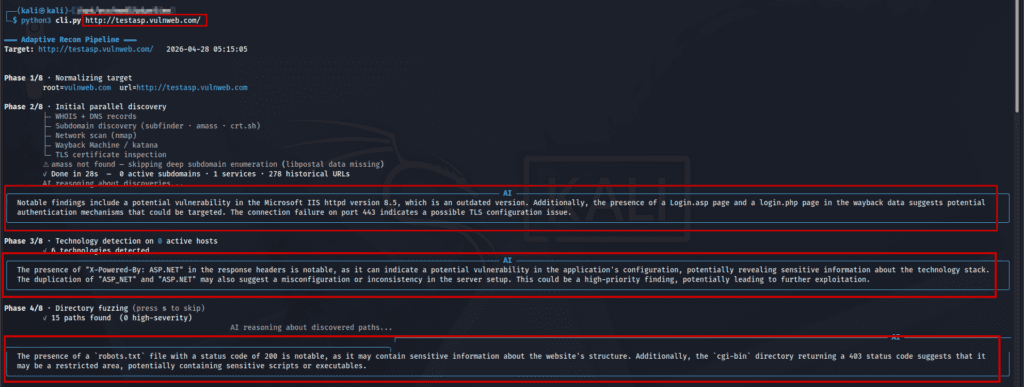
The process begins with target normalization and broad discovery, where assets, subdomains, exposed services, and historical intelligence are collected in parallel. From there, AI-assisted correlation helps prioritize live assets and identify areas worth deeper attention.
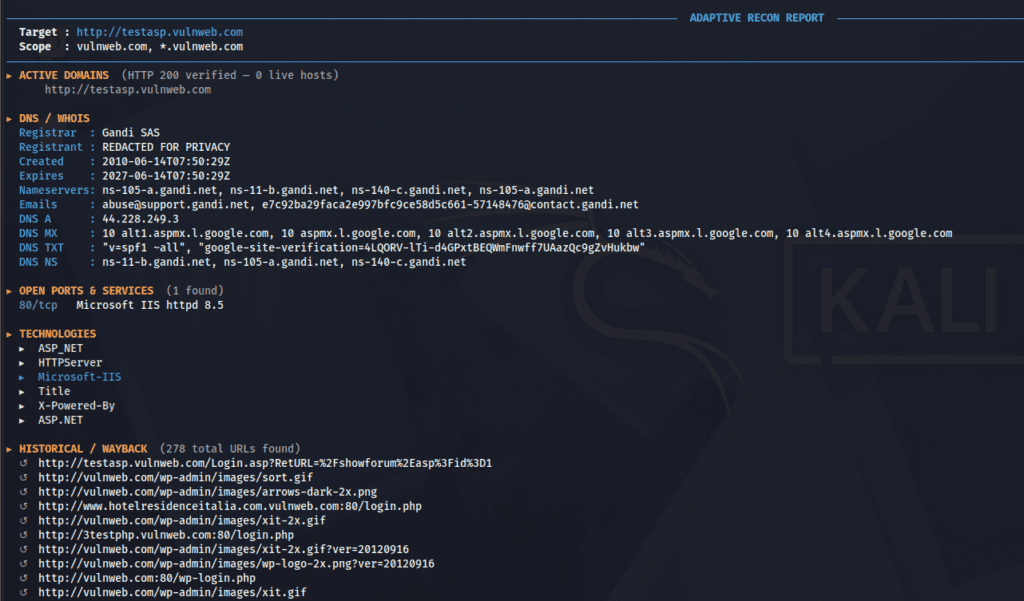
As reconnaissance progresses, adaptive endpoint exploration, JavaScript analysis and vulnerability correlation feed into a broader offensive picture, allowing the operator to move beyond raw enumeration toward identifying likely attack paths.
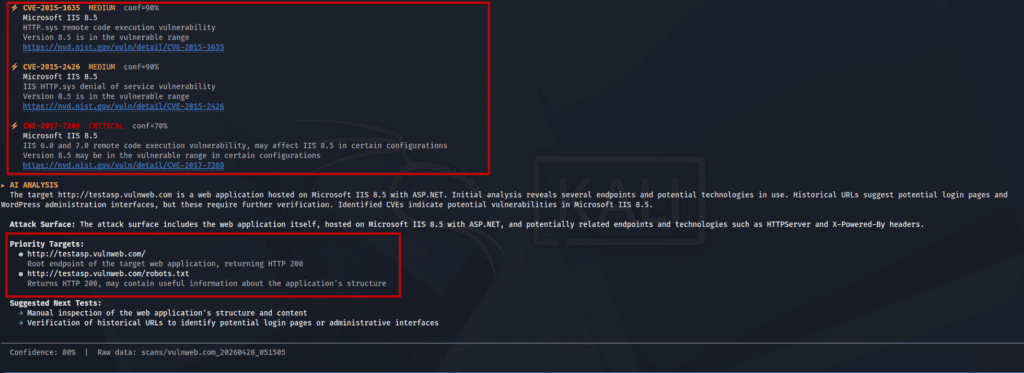
This is where AI orchestration becomes valuable.The objective is not simply faster recon.It is smarter recon.
Workflow:
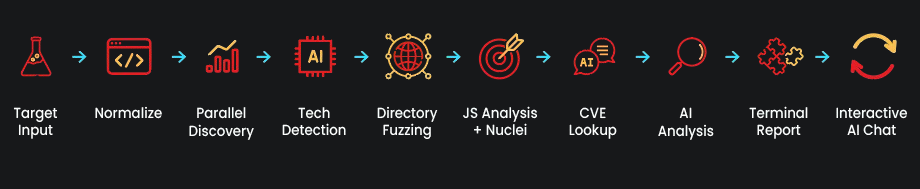
What Changes with AI in the Loop
What makes this model interesting is not just automation. It is feedback.
Each stage can influence the next. Discovery can shape deeper enumeration. Version findings can influence vulnerability analysis. Attack surface signals can be correlated continuously rather than only after the tool execution finishes.
That creates a reconnaissance workflow that is more adaptive than linear.
And in many offensive engagements, that can lead to deeper coverage and stronger attack hypotheses.
For operators, the value is simple: less time managing tooling, More time analyzing targets. That is operational leverage.
Where This Is Heading
One example is artificial intelligence-enabled reconnaissance. As intelligent automation and AI-supported offensive tradecraft evolve into agentic workflows, it is becoming increasingly apparent that offensive operations are being enhanced, not purely manual.
Modern offensive skill development is increasingly including learning how to leverage AI effectively in these workflows.
And for practitioners who are thinking about that shift, structured learning around offensive operations with AI is especially useful.
Learning More About AI in Offensive Operations
For practitioners interested in going deeper into these ideas, Offensive Cyber Operations with AI (OCO-AI) explores how AI can be operationalized across the offensive spectrum, not just as assistance during reconnaissance, but across the full cyber kill chain.
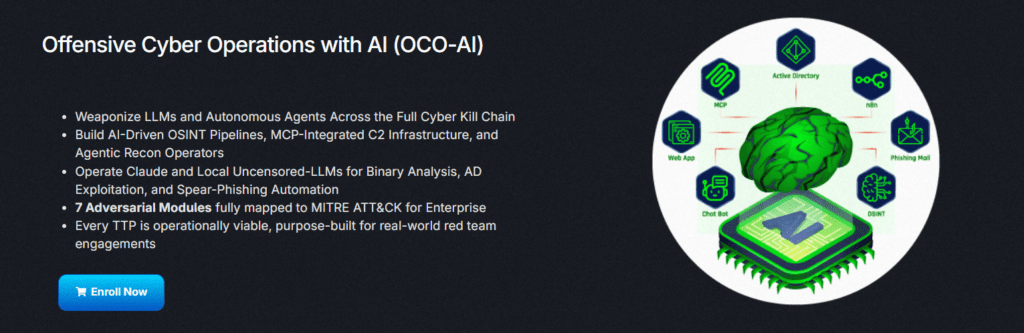
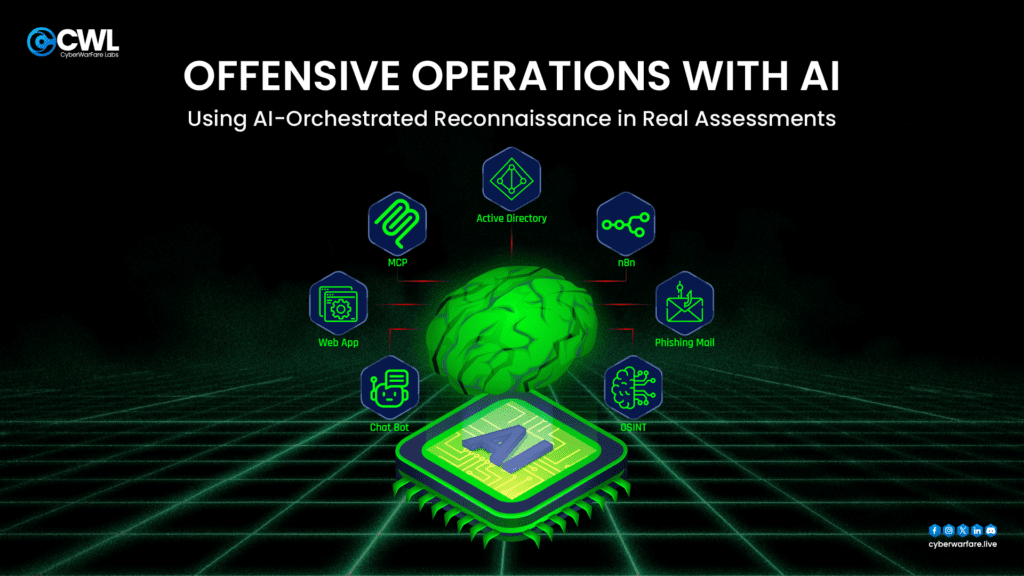
Offensive Cyber Operations with AI (OCO-AI) focuses on the offensive applications of AI in practice throughout the cyber kill chain, such as AI-powered OSINT pipelines and autonomous reconnaissance operators, MCP-integrated command-and-control concepts, LLM-powered binary analysis, Active Directory pathfinding, spear-phishing automation, and AI-augmented post-exploitation tradecraft. Instead of treating AI as a standalone topic, the course focuses on how large language models and autonomous agents can support real-world offensive workflows through operationally relevant TTPs mapped to red team scenarios.
It is about practicality the whole time – not just what offensive AI is capable of doing, but how it can be put to use in meaningful ways in real engagements. If you are interested in the ideas explored in this article regarding AI-assisted offensive operations and want to go deeper into autonomous agents, offensive AI tradecraft, and emerging red team workflows, Offensive Cyber Operations with AI is a strong next step to continue learning.
Conclusion
AI isn’t replacing offensive tradecraft, it’s letting it mature. This is particularly true in the case of reconnaissance, where the attack surface and complexity are growing, and AI is becoming increasingly useful to augment discovery, correlation and offensive decision making.It provides offensive operators a chance to operate with more speed, more context, and a new layer of intelligence baked into operations. Already that change is beginning. The real question is how many practitioners will get to use it.